Two kernels check OpenAI’s Lean proof on Siegel zeros
On October 6, OpenAI published openai/math, a repository of manuscripts with Lean formalizations. One entry accompanies the preprint “Uniform exclusion of Landau–Siegel zeros”. Its Lean statement says that there is an absolute constant c > 0 such that, for every modulus q ≥ 3, every primitive real Dirichlet character χ modulo q, and every real zero β of L(s, χ) with 0 < β < 1, we have (1 − β) log q ≥ c. The statement is quoted in full at the end of this note.
Before we build on a result, we kernel-check it, and we publish the check. This note is that check for OpenAI’s entry: what we checked, how, what it shows, and how to repeat it.
What we checked
The two theorems that OpenAI’s own checking configuration names,
exists_absolute_real_zero_gap and dirichletRealZeroBound_proof, in the
module OAI.NumberTheory.SiegelZeros.Main, at commit
fd4aeeb2
(the head of the main branch when we fetched it, October 10), with the Lean 4.34.1 toolchain and the
Mathlib release the repository pins. The configuration
(lean/ComparatorChallenges/SiegelZeros.json) permits the three standard axioms
propext, Classical.choice and Quot.sound, and leaves its option for a
second kernel switched off.
We were not the first to check this entry. On October 9, Joseph M. Reilly
published a verification package for it,
siegel-zeros-audit
(doi:10.5281/zenodo.23269528), at
an earlier commit, adc7f12; between it and fd4aeeb2 the 311 files of the
Siegel development, the challenge files and the build pins are unchanged. It ran
the Lean FRO’s Comparator tool
(leanprover/comparator) on Linux
with the network blocked and nanoda switched on as the second kernel, which we did not do, and it goes further than this
note: it formalizes the preprint’s own proof of its Lemma 3, reroutes the Lean
proof through it, and checks several of the paper’s statements by exact
computation at small cases. Its run and ours used the same nanoda commit, so on
the second kernel the two are one implementation run twice, not two. Beside it,
this note gives a second build on a different machine and operating system, two
controls that a configuration allowing only the three standard axioms refuses,
and a check of the whole environment the proof module loads.
Lean’s kernel
We built the proof from source. lake update applied the repository’s 23
compatibility patches to its dependencies and reproduced the committed
lake-manifest.json exactly. Mathlib’s compiled files came from Mathlib’s
binary cache. The 318 modules built here, OpenAI’s 306 and 12 that its patches
add to a dependency, compiled with no errors, and Lean’s kernel checked each
declaration in them as it was built.
Two short Lean files then did four things. The first printed the axioms of
both theorems. It restated the two statements of OpenAI’s challenge file word
for word and proved each by the corresponding theorem. It printed the fully
elaborated types of the two theorems, and the second file printed the same
types on the challenge side; the two sides matched byte for byte. Together, the
restatements and the comparison show that the proved statements are the
challenged ones. And the first file planted a control theorem proved by
sorry.
Both theorems depend on exactly propext, Classical.choice and Quot.sound.
Of the five declarations the first file prints axioms for, the control is the
only one whose axioms include sorryAx.
A second kernel
Lean’s kernel trusts the compiled Mathlib files it loads. To check those too, we exported the proof with lean4export and checked the export with nanoda, an independent type checker for Lean written in Rust.
The dependency closure of the two theorems is 122,700 declarations, from Lean’s
core library through Mathlib to OpenAI’s proof. nanoda checked all of them with
only the three standard axioms permitted and any other axiom a hard error, and
its own report of the axioms it admitted names exactly those three. The same
configuration refuses two controls: the challenge file’s sorry versions of the
two statements (refused for sorryAx), and Lean.reduceBool (refused for
Lean.trustCompiler).
We also checked the whole environment the proof module loads, 725,869
declarations, with nanoda. That run needs Lean.trustCompiler permitted as
well, because the environment contains declarations that use it; the closure of
the two theorems does not.
What this shows, and what it does not
It shows that OpenAI’s Lean proof proves OpenAI’s Lean statement, under two independent kernel implementations, with the three standard axioms and nothing else. (nanoda’s configuration below turns on its fast arithmetic for natural number and string literals. These are not axioms; Lean’s own kernel accelerates the same literals.)
It does not show that the preprint’s mathematics is right as written, or that
the Lean statement says what the preprint claims; that is a question for
readers of the statement, and the statement is short. A human audit of an
earlier OpenAI release makes the same point, that a successful kernel check
establishes the proposition as encoded (Sienicki and Sienicki,
arXiv:2608.14673). It does not check
lean4export or nanoda themselves, which we trust at the commits named below. We
ran both kernels on one Mac, and did not run Comparator, whose sandbox requires
Linux; Reilly’s package did. At fd4aeeb2, the repository’s own metadata gives its
review status as “unchecked”.
How to repeat it
The proof and Lean’s kernel:
git clone --filter=blob:none --no-checkout --sparse https://github.com/openai/math.git
cd math && git sparse-checkout set --cone lean
git checkout --detach fd4aeeb2ee4fc729c18d98444fed42fd0529eeeb
cd lean
lake update        # applies the patches; lake-manifest.json comes back unchanged
lake exe cache get
lake build OAI.NumberTheory.SiegelZeros.Main ComparatorChallenges.SiegelZeros
lake env lean Audit.lean
Audit.lean, placed in math/lean:
import OAI.NumberTheory.SiegelZeros.Main

open OAI.SiegelZeros.WeightedTorusJets in
set_option pp.all true in
#check @exists_absolute_real_zero_gap

open OAI.SiegelZeros.WeightedTorusJets in
set_option pp.all true in
#check @dirichletRealZeroBound_proof

#print axioms OAI.SiegelZeros.WeightedTorusJets.exists_absolute_real_zero_gap
#print axioms OAI.SiegelZeros.WeightedTorusJets.dirichletRealZeroBound_proof

def ChallengeStmt1 : Prop :=
    ∃ c : ℝ, 0 < c ∧
      ∀ (q : ℕ) [NeZero q], 3 ≤ q →
      ∀ χ : DirichletCharacter ℂ q,
        χ.IsPrimitive → χ ≠ 1 → (∀ a : ZMod q, (χ a).im = 0) →
        ∀ β : ℝ, 0 < β → β < 1 → χ.LFunction (β : ℂ) = 0 →
          c ≤ (1 - β) * Real.log (q : ℝ)

def ChallengeStmt2 : Prop :=
    ∃ c : ℝ, 0 < c ∧ ∀ (q : ℕ) [NeZero q], 3 ≤ q →
      ∀ χ : DirichletCharacter ℂ q,
        χ.IsPrimitive → χ ≠ 1 → (∀ a : ZMod q, (χ a).im = 0) →
        ∀ β : ℝ,
          (0 < β ∧ β < 1 ∧ DirichletCharacter.LFunction χ (β : ℂ) = 0) →
            c ≤ (1 - β) * Real.log (q : ℝ)

theorem audit_bridge1 : ChallengeStmt1 := OAI.SiegelZeros.WeightedTorusJets.exists_absolute_real_zero_gap
theorem audit_bridge2 : ChallengeStmt2 := OAI.SiegelZeros.WeightedTorusJets.dirichletRealZeroBound_proof

theorem audit_control : ChallengeStmt1 := by sorry

#print axioms audit_bridge1
#print axioms audit_bridge2
#print axioms audit_control
The same two #check commands with import ComparatorChallenges.SiegelZeros
print the challenge side’s types for the comparison.
The second kernel:
git clone https://github.com/leanprover/lean4export.git
cd lean4export && git checkout v4.34.0      # 076e8e5
echo 'leanprover/lean4:v4.34.1' > lean-toolchain && lake build && cd ..
git clone https://github.com/ammkrn/nanoda_lib.git
cd nanoda_lib && git checkout 3a24072 && cargo build --release && cd ..

cd math/lean
lake env ../../lean4export/.lake/build/bin/lean4export OAI.NumberTheory.SiegelZeros.Main -- \
  OAI.SiegelZeros.WeightedTorusJets.exists_absolute_real_zero_gap \
  OAI.SiegelZeros.WeightedTorusJets.dirichletRealZeroBound_proof > closure.ndjson
../../nanoda_lib/target/release/nanoda_bin config.json
with config.json:
{
    "export_file_path": "closure.ndjson",
    "use_stdin": false,
    "permitted_axioms": ["propext", "Classical.choice", "Quot.sound"],
    "unpermitted_axiom_hard_error": true,
    "nat_extension": true,
    "string_extension": true,
    "print_success_message": true,
    "pp_to_stdout": true
}
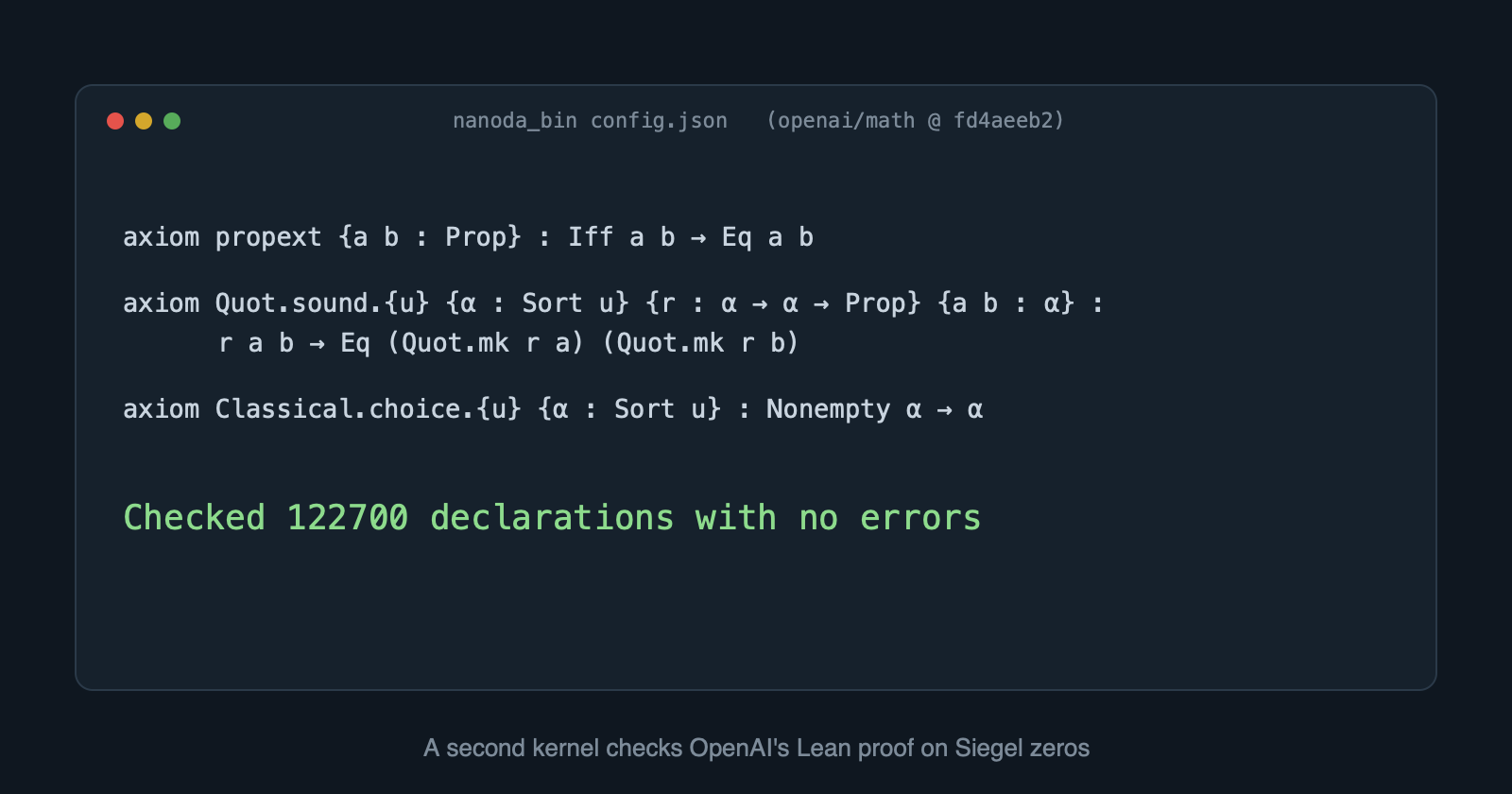
nanoda’s output ends:
axiom propext {a b : Prop} : Iff a b → Eq a b

axiom Quot.sound.{u} {α : Sort u} {r : α → α → Prop} {a b : α} : r a b → Eq (Quot.mk r a) (Quot.mk r b)

axiom Classical.choice.{u} {α : Sort u} : Nonempty α → α

Checked 122700 declarations with no errors
The two controls use the same configuration with export_file_path pointed at
their own exports:
lake env ../../lean4export/.lake/build/bin/lean4export ComparatorChallenges.SiegelZeros -- \
  OAI.SiegelZeros.WeightedTorusJets.exists_absolute_real_zero_gap \
  OAI.SiegelZeros.WeightedTorusJets.dirichletRealZeroBound_proof > challenge.ndjson
lake env ../../lean4export/.lake/build/bin/lean4export Init -- Lean.reduceBool > reduceBool.ndjson
nanoda stops on each with Error: export file declares unpermitted axiom "sorryAx" and "Lean.trustCompiler" respectively.
On our machine the export was 1.3 GB and nanoda’s check took two minutes. Fetching the dependencies and the Mathlib cache used about 22 GB of disk.
The statement
From lean/ComparatorChallenges/SiegelZeros.lean at fd4aeeb2, where the proof
is replaced by sorry:
theorem exists_absolute_real_zero_gap :
    ∃ c : ℝ, 0 < c ∧
      ∀ (q : ℕ) [NeZero q], 3 ≤ q →
      ∀ χ : DirichletCharacter ℂ q,
        χ.IsPrimitive → χ ≠ 1 → (∀ a : ZMod q, (χ a).im = 0) →
        ∀ β : ℝ, 0 < β → β < 1 → χ.LFunction (β : ℂ) = 0 →
          c ≤ (1 - β) * Real.log (q : ℝ)
The second theorem, dirichletRealZeroBound_proof, states the same bound with
the three conditions on β bundled into one hypothesis.
The checks were run by Claude agents working under my direction.